


What to See in Ephesus
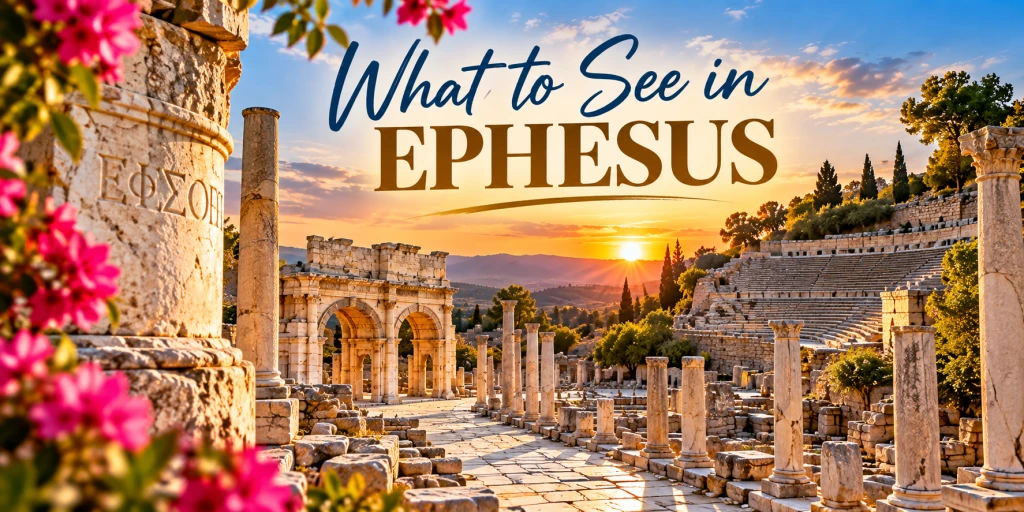
What to See in Ephesus: 10 Must-See Ancient Highlights
Ephesus is much more than a single ancient monument. It is an entire city of marble streets, temples, theatres, fountains, public buildings and beautifully decorated Roman homes.
Located near Selçuk on Türkiye's Aegean coast, Ephesus was one of the most important cities of the ancient Mediterranean. Today, walking through its archaeological site offers an extraordinary opportunity to experience the scale and sophistication of urban life during the Roman period.
If you are planning your first visit, here are 10 must-see highlights in Ephesus that should be on your list.
1. Library of Celsus
The Library of Celsus is the most recognizable landmark in Ephesus and one of the great architectural highlights of the ancient city.
Built during the Roman period in honour of Tiberius Julius Celsus Polemaeanus, the library once housed thousands of scrolls.
Its monumental two-storey façade features elegant columns, decorative stonework and statues representing virtues associated with Celsus.
Today, standing in front of the Library of Celsus is one of the unforgettable moments of any visit to Ephesus.
2. Curetes Street
Curetes Street is one of the main ancient streets running through Ephesus.
Walking down this marble-paved route gives visitors an excellent sense of how the city was organized.
Along the street you will encounter the remains of temples, fountains, shops and important public buildings.
Look closely at the marble beneath your feet. Ephesus is full of small details that reveal how people lived and moved through the city nearly two thousand years ago.
3. Terrace Houses
The Terrace Houses provide a fascinating glimpse into the private lives of Ephesus' wealthier residents.
Built into the hillside opposite the Temple of Hadrian, these luxurious Roman residences contain beautiful mosaics, frescoes, marble floors and sophisticated architectural features.
Protective walkways allow visitors to view the archaeological remains while observing ongoing conservation work.
The Terrace Houses generally require a separate admission ticket, but they are particularly worthwhile for anyone interested in Roman art and daily life.
4. Great Theatre of Ephesus
The Great Theatre is one of the largest and most dramatic structures in Ephesus.
Built into the slope of Panayır Mountain and expanded during the Roman period, it could accommodate thousands of spectators.
The theatre hosted performances, public gatherings and other events.
It also has an important connection with early Christianity through the story of St. Paul in Ephesus, described in the Acts of the Apostles.
Standing inside the enormous seating area gives a remarkable impression of just how important and populous ancient Ephesus once was.
5. Temple of Hadrian
Located along Curetes Street, the Temple of Hadrian is one of the most elegant monuments within Ephesus.
Its distinctive curved arch, Corinthian columns and decorative stonework make it immediately recognizable.
Although smaller than monuments such as the Library of Celsus or Great Theatre, the temple is an excellent example of the architectural detail found throughout the ancient city.
6. Fountain of Trajan
The Fountain of Trajan was one of the impressive public fountains that decorated ancient Ephesus.
Built in honour of the Roman Emperor Trajan, the structure originally featured an elaborate façade surrounding a pool.
Although only part of the original monument survives, its remains demonstrate the importance of fountains both as practical sources of water and as expressions of civic prestige in Roman cities.
7. Temple of Domitian
The Temple of Domitian area provides another glimpse into the political and religious life of Roman Ephesus.
The temple complex was associated with the imperial cult and reflects the close relationship between religion, civic identity and Roman imperial authority.
Its surviving remains also help visitors understand the monumental scale of the upper part of the ancient city.
8. Odeon
Near the upper entrance of Ephesus stands the Odeon, a smaller theatre-like structure.
Unlike the enormous Great Theatre, the Odeon was used for more intimate gatherings and is believed to have served as both a concert venue and a meeting place for civic affairs.
Its semicircular seating provides an excellent introduction to the public architecture of Ephesus.
9. Commercial Agora
Near the Library of Celsus lies the Commercial Agora, once one of the busiest areas of Ephesus.
Merchants and traders gathered here, and goods from across the Mediterranean passed through the city.
The agora reminds visitors that Ephesus was not only a religious and cultural centre but also a major commercial city whose prosperity was closely connected to trade.
10. Marble Street
Marble Street connects important sections of the ancient city and once formed part of the route between the Library of Celsus and the Great Theatre.
Walking along the surviving marble paving provides another opportunity to imagine daily life in Roman Ephesus.
The street also offers impressive views toward several of the city's major monuments.
What Else Can You See Near Ephesus?
The archaeological site is only part of the historical experience available in the region.
If you have additional time, several important sites can easily be combined with Ephesus.
House of the Virgin Mary
Located on Mount Koressos near Ephesus, the House of the Virgin Mary is an important pilgrimage destination associated with the Christian tradition that Mary spent her later years in the area.
Temple of Artemis
The Temple of Artemis was once one of the Seven Wonders of the Ancient World.
Only limited remains survive today, but the site's historical significance makes it an important part of the story of ancient Ephesus.
Basilica of St. John
Located on Ayasuluk Hill in Selçuk, the Basilica of St. John was constructed over the site traditionally believed to be the burial place of St. John the Apostle.
How Much Time Do You Need to See Ephesus?
Most visitors should allow approximately two to three hours to explore the main archaeological site comfortably.
If you plan to visit the Terrace Houses or prefer to examine the monuments in greater detail, allow additional time.
Combining Ephesus with the House of the Virgin Mary, Basilica of St. John or other nearby attractions can turn the visit into a half-day or full-day experience.
Tips for Exploring Ephesus
Ephesus involves considerable walking over ancient stone and marble surfaces, so comfortable footwear is essential.
During warmer months, bring water, sun protection, sunglasses and a hat. Much of the archaeological site is outdoors, and shade can be limited.
Morning visits are often particularly comfortable during the hotter summer months.
Most importantly, do not rush.
Some of the most interesting details in Ephesus are found between the famous monuments: inscriptions, columns, mosaics, ancient water systems and traces of everyday life.
Discover More Than the Famous Landmarks
The Library of Celsus may be the image most travellers associate with Ephesus, but the real experience comes from exploring the ancient city as a whole.
Walk its marble streets, step inside its Roman homes, stand in the Great Theatre and look closely at the details left behind by generations who lived here.
Ephesus rewards curiosity.
The more time you spend exploring, the more the ancient city begins to reveal its story.
Ready to experience these ancient landmarks for yourself? Explore our Ephesus Tours and discover the city at your own pace.