


Explore Ephesus
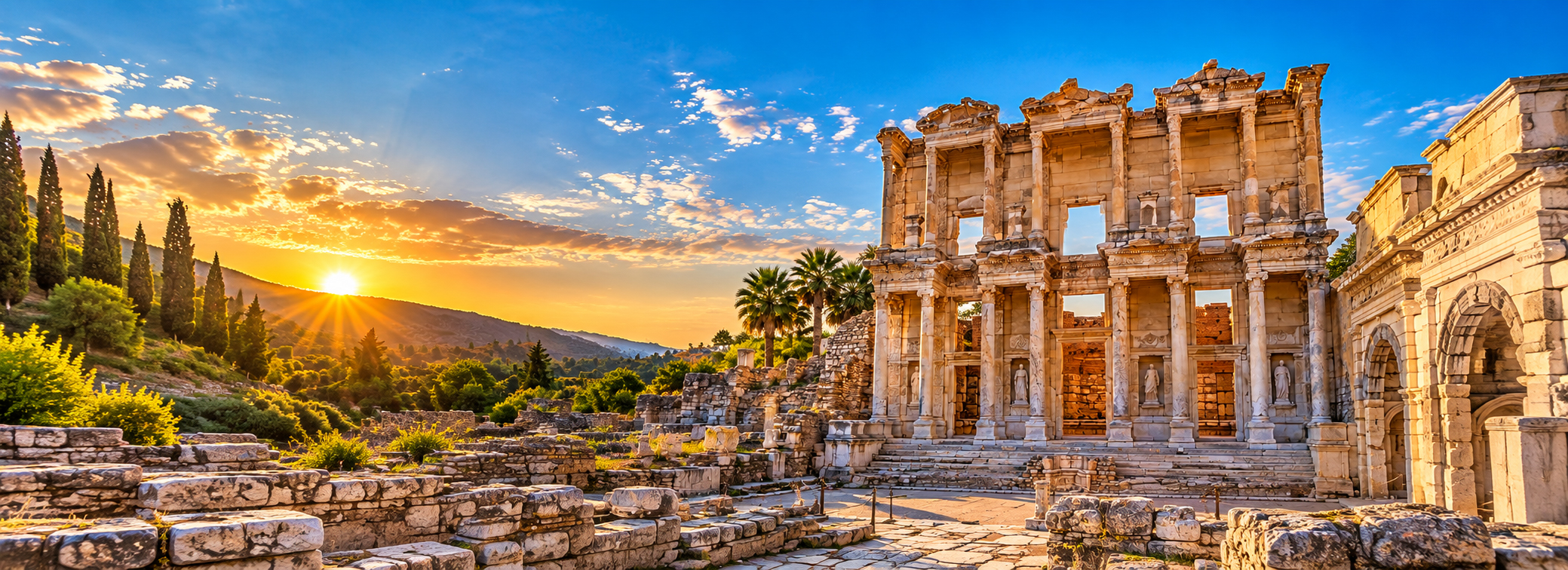
Explore Ephesus: A Complete Guide to the Ancient City
Step into history and discover Ephesus, one of the most remarkable ancient cities in the Mediterranean.
Located near Selçuk on Türkiye's Aegean coast, Ephesus is a place where thousands of years of history can still be experienced along ancient streets, monumental buildings and beautifully preserved ruins.
Once an important Greek settlement and later one of the great cities of the Roman Empire, Ephesus became a major centre of trade, culture and religion. Today, visitors can walk through the same streets once used by merchants, citizens, philosophers and pilgrims and discover some of the most impressive remains of the ancient world.
Whether you are visiting from Kusadasi, Izmir or as a cruise passenger arriving at Kusadasi Port, Ephesus offers far more than a collection of ruins. It is a journey through the civilizations that shaped the Aegean and the Mediterranean.
The Story of Ephesus
The history of Ephesus stretches back thousands of years.
The city developed under Greek influence and later flourished during the Roman period, when it became the capital of the Roman province of Asia and one of the most important cities in the eastern Mediterranean.
Its strategic location and harbour helped Ephesus grow into a prosperous commercial centre. Magnificent public buildings, temples, fountains, baths, theatres and private residences reflected the wealth and importance of the city.
Over the centuries, changes to the coastline and the silting of its harbour gradually affected Ephesus. The city eventually lost much of its commercial importance, but its extraordinary archaeological remains survived.
Today, the archaeological site of Ephesus forms part of the UNESCO World Heritage List and welcomes visitors from around the world.
Ancient City of Ephesus
Walking through Ephesus is one of the best ways to understand the scale and sophistication of an ancient Roman city.
The archaeological site includes monumental gates, temples, fountains, public baths, administrative buildings, residential areas and streets paved with marble.
Among its most memorable areas is Curetes Street, which connects several of the city's major monuments. Walking along this ancient street provides a remarkable impression of everyday urban life almost two thousand years ago.
Every part of Ephesus tells a different story, from grand public monuments to the remains of shops and homes once used by its inhabitants.
Library of Celsus
The Library of Celsus is perhaps the most recognizable monument in Ephesus.
Built during the Roman period in honour of Tiberius Julius Celsus Polemaeanus, the library once housed thousands of scrolls and represented the city's intellectual and cultural importance.
Its beautifully reconstructed façade, with columns, statues and elaborate architectural details, has become one of the iconic images of Ephesus.
Standing in front of the Library of Celsus is one of the highlights of any visit to the ancient city.
Terrace Houses
The Terrace Houses of Ephesus offer a very different perspective on life in the ancient city.
Located on the slopes opposite the Temple of Hadrian, these residences belonged to some of the wealthier citizens of Ephesus.
Inside, visitors can see intricate mosaics, wall paintings, marble decoration and sophisticated architectural features. The houses provide fascinating evidence of how affluent Roman families lived and decorated their homes.
The Terrace Houses require a separate entrance ticket, but they are particularly worthwhile for visitors interested in Roman art, architecture and daily life.
The Great Theatre of Ephesus
The Great Theatre is one of the largest and most impressive structures in Ephesus.
Built into the slope of Panayır Mountain and expanded during the Roman period, the theatre could accommodate thousands of spectators.
It was used for performances, public gatherings and other events. Its enormous seating area still provides an impressive sense of the scale and population of ancient Ephesus.
The theatre is also connected with the early history of Christianity and the story of St. Paul in Ephesus.
Temple of Hadrian
Situated along Curetes Street, the Temple of Hadrian is one of the most elegant monuments within Ephesus.
Its decorative façade and distinctive arch make it an excellent example of Roman architecture. Although relatively small compared with some of the city's monumental structures, its detailed stonework makes it one of the highlights along Curetes Street.
Temple of Artemis
The Temple of Artemis was once one of the Seven Wonders of the Ancient World.
Dedicated to Artemis, the sanctuary made Ephesus an important religious destination in antiquity. The temple was famous throughout the ancient world for its enormous scale and architectural splendour.
Only limited remains of the temple survive today, but its historical importance is extraordinary.
The site is located near Selçuk, a short distance from the main archaeological site of Ephesus.
House of the Virgin Mary
Located on Mount Koressos (Bülbüldağı) near Ephesus, the House of the Virgin Mary is one of the region's most important religious sites.
According to Christian tradition, Mary spent the later years of her life in this area. The small stone house is visited by both Christian pilgrims and travellers from many different backgrounds.
The peaceful forest setting provides a striking contrast to the monumental ruins of Ephesus.
The House of the Virgin Mary is located outside the main Ephesus archaeological site and requires separate admission.
Basilica of St. John
The Basilica of St. John stands on Ayasuluk Hill in Selçuk.
The basilica was constructed during the Byzantine period over the site traditionally believed to be the burial place of St. John the Apostle.
Although much of the structure is now in ruins, its remaining columns, walls and foundations reveal the enormous scale of the original church.
From Ayasuluk Hill, visitors can also enjoy impressive views across Selçuk and the surrounding landscape.
Ephesus and Early Christianity
Ephesus holds an important place in the history of Christianity.
The city is associated with St. Paul, St. John the Apostle and traditions surrounding the Virgin Mary.
St. Paul spent considerable time in Ephesus during his missionary journeys, and the city appears prominently in the New Testament. The Epistle to the Ephesians and references in the Acts of the Apostles have made Ephesus particularly significant for Christian visitors.
Together with the House of the Virgin Mary and Basilica of St. John, the ancient city forms one of the most important Biblical destinations in western Türkiye.
Şirince Village
A visit to the Ephesus region can also be combined with Şirince, a picturesque hillside village near Selçuk.
Known for its traditional houses, narrow streets, local products and relaxed atmosphere, Şirince offers a pleasant contrast to the ancient monuments of Ephesus.
The village is surrounded by hills, vineyards and olive groves and is a popular stop for travellers who would like to experience another side of the region.
Where Is Ephesus?
Ephesus is located near the town of Selçuk in Izmir Province, on the Aegean coast of Türkiye.
Approximate distances are:
- Selçuk: 3 km
- Kusadasi: 20 km
- Kusadasi Cruise Port: 20 km
- Izmir: 80 km
- Izmir Adnan Menderes Airport: 60 km
Its location makes Ephesus particularly convenient for travellers staying in Kusadasi, Selçuk and Izmir as well as cruise passengers visiting Kusadasi for the day.
How to Get to Ephesus
Ephesus can be reached from several destinations along Türkiye's Aegean coast.
From Kusadasi
Kusadasi is one of the closest major tourism centres to Ephesus. Travelling by private vehicle normally takes approximately 25–30 minutes, depending on traffic and the pickup location.
From Kusadasi Cruise Port
Ephesus is one of the most popular destinations for cruise passengers arriving at Kusadasi Port.
Its proximity to the port makes it possible to explore Ephesus comfortably during a cruise stop while allowing sufficient time to return to the ship.
Cruise passengers should always plan their visit according to the ship's arrival and all-aboard time.
From Izmir
Visitors staying in Izmir can reach Ephesus by road or rail via Selçuk. The journey by private vehicle generally takes around one hour, depending on traffic and the departure point.
From Izmir Airport
Izmir Adnan Menderes Airport (ADB) is approximately 60 kilometres from Ephesus. Private transfers provide one of the most convenient options for travellers arriving by air.
Best Time to Visit Ephesus
Ephesus can be visited throughout much of the year, but spring and autumn generally provide the most comfortable conditions.
April, May, September and October usually offer pleasant temperatures for walking through the archaeological site.
During July and August, temperatures can become very high, particularly around midday. An early morning visit is often preferable during the summer months.
Winter tends to be quieter and can provide an enjoyable experience for visitors who prefer fewer crowds, although rainy days are more common.
How Long Do You Need at Ephesus?
Most visitors should allow approximately two to three hours for the main archaeological site.
Visitors who wish to explore the Terrace Houses in detail may need additional time.
A broader visit including the House of the Virgin Mary, Basilica of St. John or Temple of Artemis can easily take half a day or longer.
The ideal amount of time depends on your interests and how deeply you would like to explore the history of the region.
What to Wear and Bring
Ephesus is a large open-air archaeological site with considerable walking.
Comfortable walking shoes are strongly recommended because many surfaces are ancient, uneven and made of marble or stone.
During warmer months, visitors should consider bringing:
- Comfortable footwear
- Water
- Sun protection
- Sunglasses
- A hat
- Lightweight clothing
There is limited shade inside parts of the archaeological site, making sun protection particularly important during summer.
Ephesus for Cruise Passengers
For travellers arriving at Kusadasi Cruise Port, Ephesus is one of the most accessible major archaeological sites in the region.
Because ships have different arrival and departure schedules, cruise visitors should plan their time carefully.
Private arrangements can provide greater flexibility because the itinerary can be organized around the ship's schedule rather than a fixed large-group programme.
When planning your visit, always keep the ship's all-aboard time in mind and allow sufficient time for the return journey to Kusadasi Port.
Visiting Ephesus Responsibly
Ephesus is not simply a tourist attraction. It is an archaeological site preserving thousands of years of human history.
Visitors should remain within designated areas, avoid touching fragile archaeological surfaces and follow instructions provided by site authorities.
Responsible tourism helps protect Ephesus so future generations can continue to experience this extraordinary place.
Frequently Asked Questions About Ephesus
Is Ephesus worth visiting?
Yes. Ephesus is one of the most extensive ancient cities that can be visited in the eastern Mediterranean and contains remarkably preserved examples of Roman architecture and urban planning.
Can I visit Ephesus from Kusadasi?
Yes. Ephesus is approximately 20 kilometres from Kusadasi and is easily accessible for both hotel guests and cruise passengers.
Can I visit Ephesus from Izmir?
Yes. Ephesus can comfortably be visited as a day trip from Izmir.
Are the Terrace Houses included with Ephesus?
The Terrace Houses are located inside the archaeological site but generally require a separate admission ticket.
Is the House of the Virgin Mary inside Ephesus?
No. The House of the Virgin Mary is located on Mount Koressos near Ephesus and has a separate entrance.
Is the Temple of Artemis inside the Ephesus archaeological site?
No. The remains of the Temple of Artemis are located near Selçuk and are separate from the main Ephesus archaeological site.
Is Ephesus suitable for children?
Families can visit Ephesus, but parents should consider the amount of walking, uneven surfaces and summer temperatures when planning their visit.
Do I need a guide to visit Ephesus?
A guide is not mandatory for visiting Ephesus. However, the archaeological site contains many layers of Greek, Roman, Byzantine and early Christian history, and professional interpretation can provide additional historical context.
Discover Ephesus Your Way
Ephesus is a place where history is not hidden behind museum glass.
Here, you can walk along ancient marble streets, stand before the Library of Celsus, enter homes decorated nearly two thousand years ago and experience the remains of a city that once played an important role in the Mediterranean world.
Take your time, look beyond the monuments and discover the stories that have made Ephesus one of Türkiye's most extraordinary historical destinations.
Ready to experience Ephesus? Explore our Ephesus Tours and Shore Excursions.